
Is ‘Good’ Prosecco, Good?
Asolo Prosecco

The Asolo Prosecco Consortium has fed me well, too well. I’m plump, ripe, and ready for picking off a sofa. The Consortium, established in 1985 to ‘protect and promote’ Asolo Prosecco, kindly hosted a press meal and masterclass at the Shard’s Oblix restaurant. The meal was advertised as small, just like the town of Asolo in Veneto, North East Italy. It’s a place where the Dolomite mountains peer over steep sloping vineyards, moist cyclists, and mediaeval buildings. The Prosecco made here isn’t the stuff filling Britain’s plastic wine flutes and leaving a wake of bubble drunk, cigarette-begging, urine decanters who pay no attention to the pear drop nose. Such is Asolo’s superior quality that any comparison is simply Google to Bing, chalk to cheese. Perhaps you’re sceptical, you think at best Asolo merely polishes the Prosecco turd but despite my sympathies for scepticism, me and my free dinner will have to disagree on this occasion.
I’ve been a smidge dismissive in characterising Prosecco, though it's worth understanding why. Anything labelled ‘Prosecco’ can be grown anywhere in Veneto and Friuli (see map below), it's a huge area dominated by flat plains that eventually peel up towards the more delicious foothills of the Dolomites. Prosecco’s popularity largely draws on the slump in Champagne sales after the 2008 financial crisis, a time when affordable bubbles were almost a prescription. The sales never let up and Prosecco became a victim of its own success, whereby the gigantic demand and annual production swallowed any focus on quality.
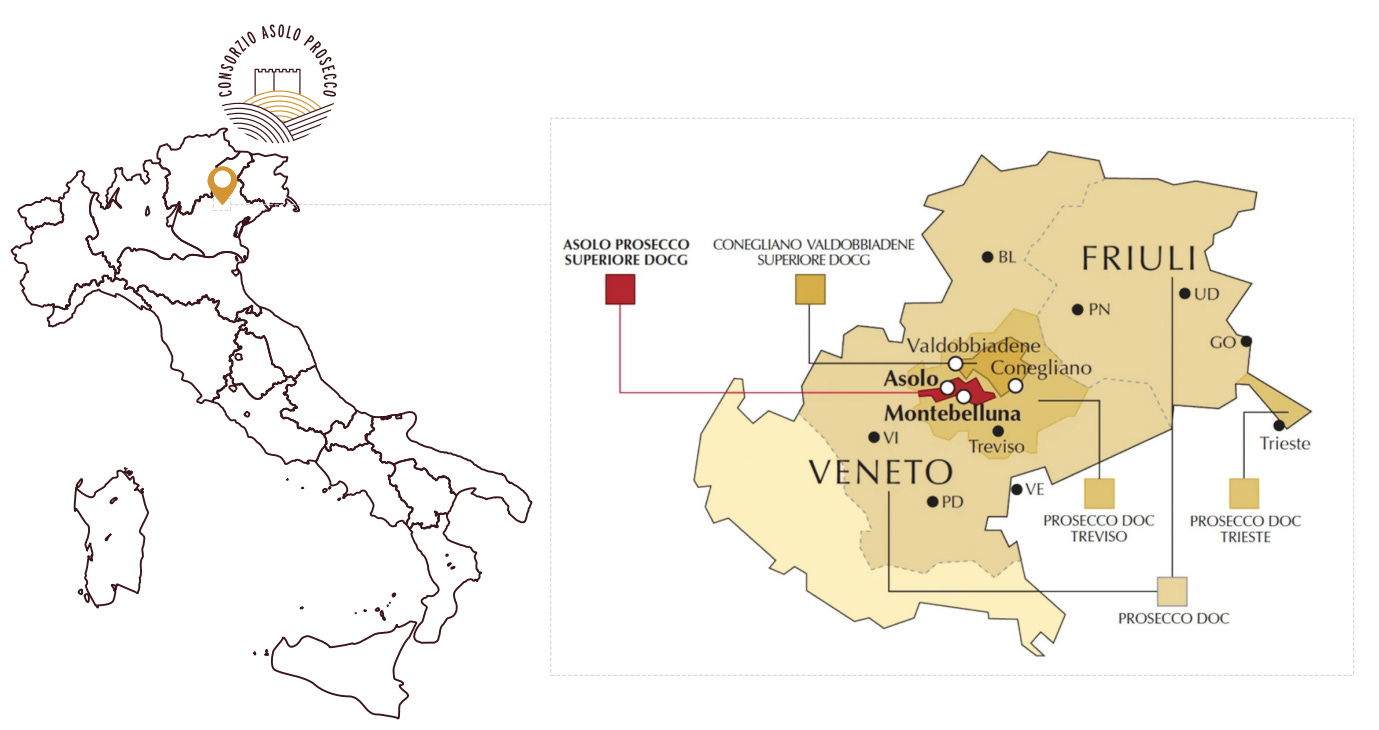
In 2023 over 600 million bottles of Prosecco were made, with the UK sucking down around 25% of that. To satisfy demand, most Prosecco is grown on the expansive flat plains of Veneto and Friuli where higher temperatures both rob the fruit of refreshing natural acidity and forces earlier harvests which prevent the fruit from developing much flavour. The resulting wines are largely manipulated, bad, and destined for lubricating gossip over mimosas.
Now picture this, a Fiat 500 driving erratically up narrow roads, Dean Martin’s voice echoes against the hillside, and the driver wipes a pasta smudge from his lips (too much?). He passes the Asolo sign and notices, aside from the gorgeous chapels, that he is now surrounded by rugged, undulating hills ranging from 100 to 400 metres above sea level. It is only amongst these hills where Asolo Prosecco can be grown and this boost in altitude cools the average temperatures allowing for both natural acidity to be retained and a significantly longer ripening season. This year, Veneto’s plains began the harvest at the end of July while Asolo’s began 2 months later in late September.
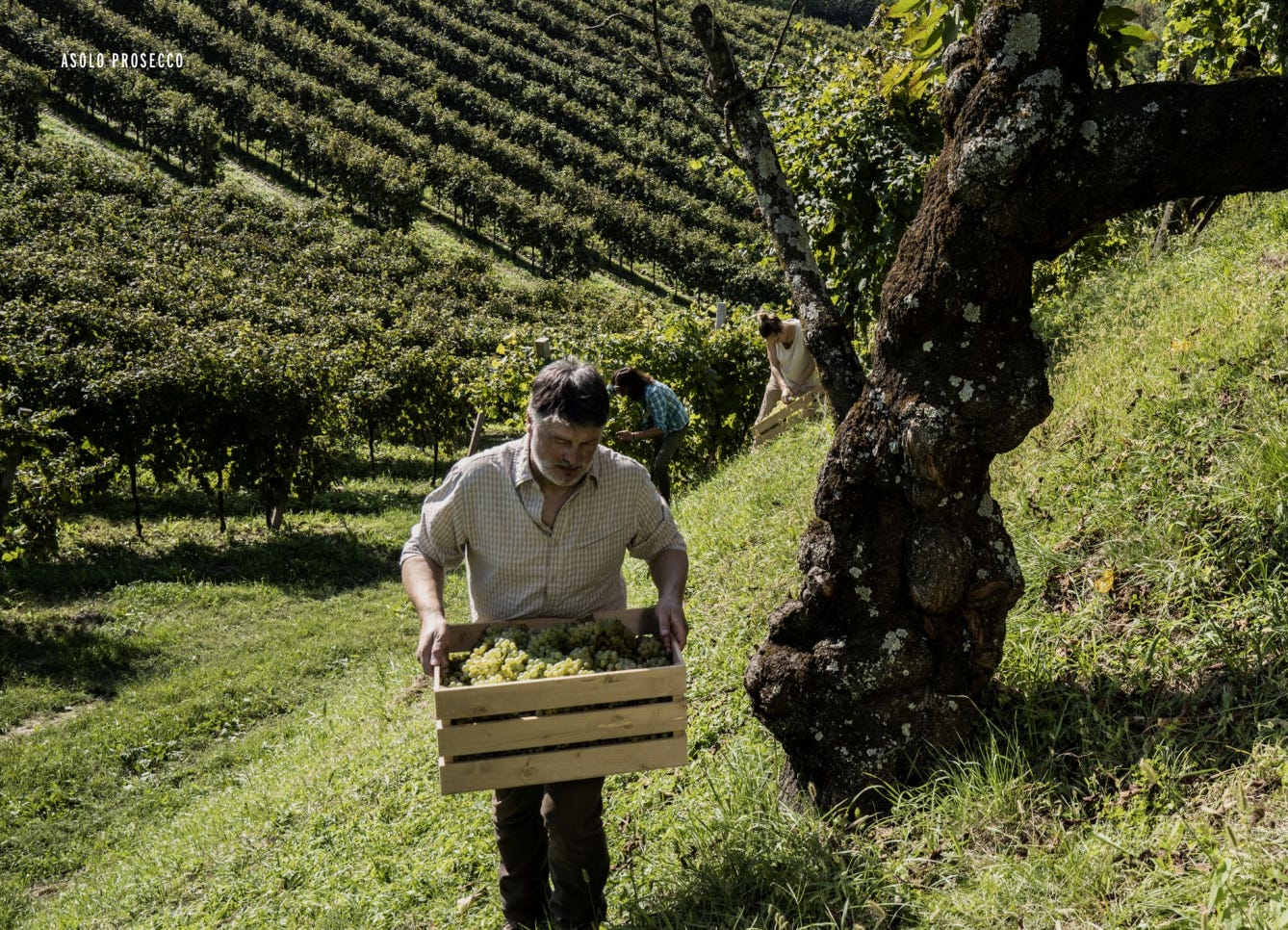
Asolo’s harvests are an impressive ordeal, the steep, rugged vineyards require hand harvesting which in turns necessitates superb knees and ensures a dreadful back. With such challenging terrain more attentive viticulture is required year round, with many vineyards certified as organic and biodynamic. The vines are also older on average meaning they tend to yield less but more concentrated fruit, most of which is the indigenous Glera grape. For the nerds, the soils are mostly marley-clay and marley-sand and rich in organic material, largely owing to the woodlands that cover a third of the region. This all adds up to Asolo’s annual production being 27 million bottles, only 4.5% of all Prosecco made. The pitch for Asolo is fairly simple then. Not only a gorgeous town, but its vineyards are better managed and better placed to grow quality fruit in lower volumes, meaning winemakers have the tools and focus to produce delicious wines to be slurped by folks wearing linen and Birkenstocks. Or in my case wearing jeans overlooking St Paul’s.
‘That chrome Rolls Royce sure looks classy’, I thought, as the Shard’s security x-rayed my bag. I had a moment to re-wrestle my scepticism. Having tasted Prosecco’s lows I imagined its ceiling being shin high and that I was due an evening of masking my distaste. Regardless, the insightful masterclass and flight of Proseccos supercharged my appetite, so my fat hands did a poor job of sharing the small plates evenly. As the ‘small’ meal kept growing I kept reaching for the same two wines.


The first was Case Paolin’s Col Fondo. Our host noted that Col Fondo, a method for making sparkling wine, is the ‘trendy Prosecco’ which makes sense considering it’s cloudy and more unusual (making up 1% of Asolo Prosecco). The method involves a second fermentation in the bottle, whereby the CO2 produced from that bottle fermentation gradually dissolves into the wine making it bubbly. The dead yeast cells or ‘lees’ (never sounds appetising) are left in the wine providing texture and a cloudier appearance. I first noticed how real the fruit smelled, it's not the candied crap you’d find in bulk Prosecco but rather like someone’s punched fresh green apples and white peaches. Something floral hits the nostrils too. It’s ‘lightly macerated’ on the skins before fermentation giving a little weight to the pallet and a chalky finish. I gladly dismantled the baked cod with a few glasses this Col Fondo, and at £17 a bottle, I’d do it again.

I was also particularly smitten with Montelvini’s ‘FM 333’ Brut Millesemato, a laser beam Prosecco that deserves to cut through the fat of roast chicken or wash down expensive tinned fish. The acidity is electric and the nose refined, a subtle marzipan and almond quality accompanies zippy pears and peach. The FM333 (catchy name) is grown at 333 metres above sea level in the ‘Fontana Masorin’ (FM) vineyard. Still made using the charmat method synonymous with Prosecco, only the first press juice is used to make the FM333, which tends to be purer and more refined. Indeed, those two words summarise this single vineyard Prosecco best, pure and refined.

Asolo Prosecco is good Prosecco, such a thing exists, the words are not oxymoronic. Asolo Prosecco belongs in proper glassware, far away from plastic flutes, and near food. The rough price difference between own-brand Prosecco and Asolo’s yummier offerings isn't huge, roughly £6, yet the difference in quality is seismic. Asolo does not polish the Prosecco turd, but rather makes delicious, affordable sparklers in its own right. ‘Prosecco’ is what goes in the mouth in volume, Asolo is what goes in the mouth with pleasure.
I have just gone online and bought two cases of various Asolo Prosecco to challenge my own pre-conceived notions . Looking forward to this
Another excellent article from the cork sucker!